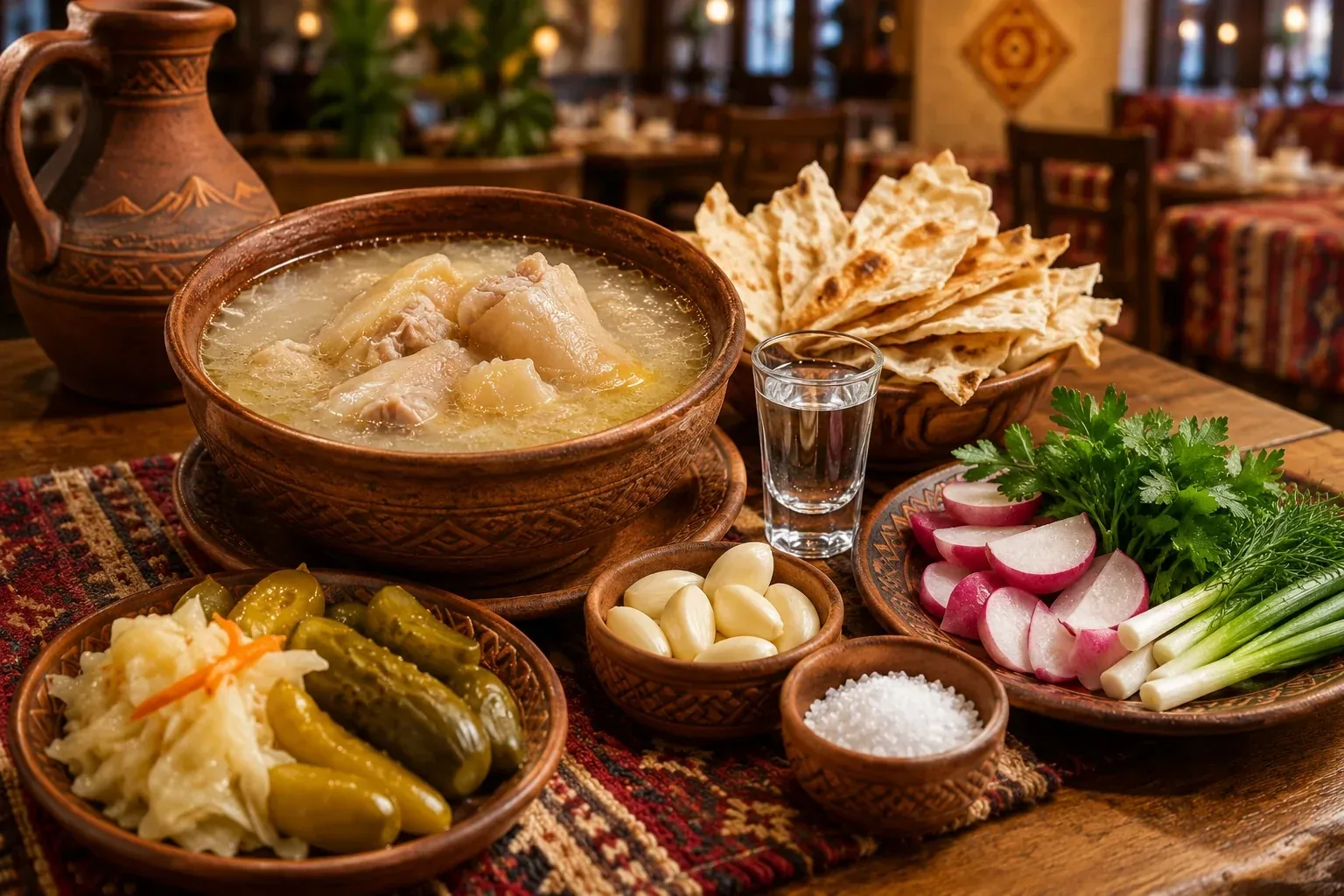
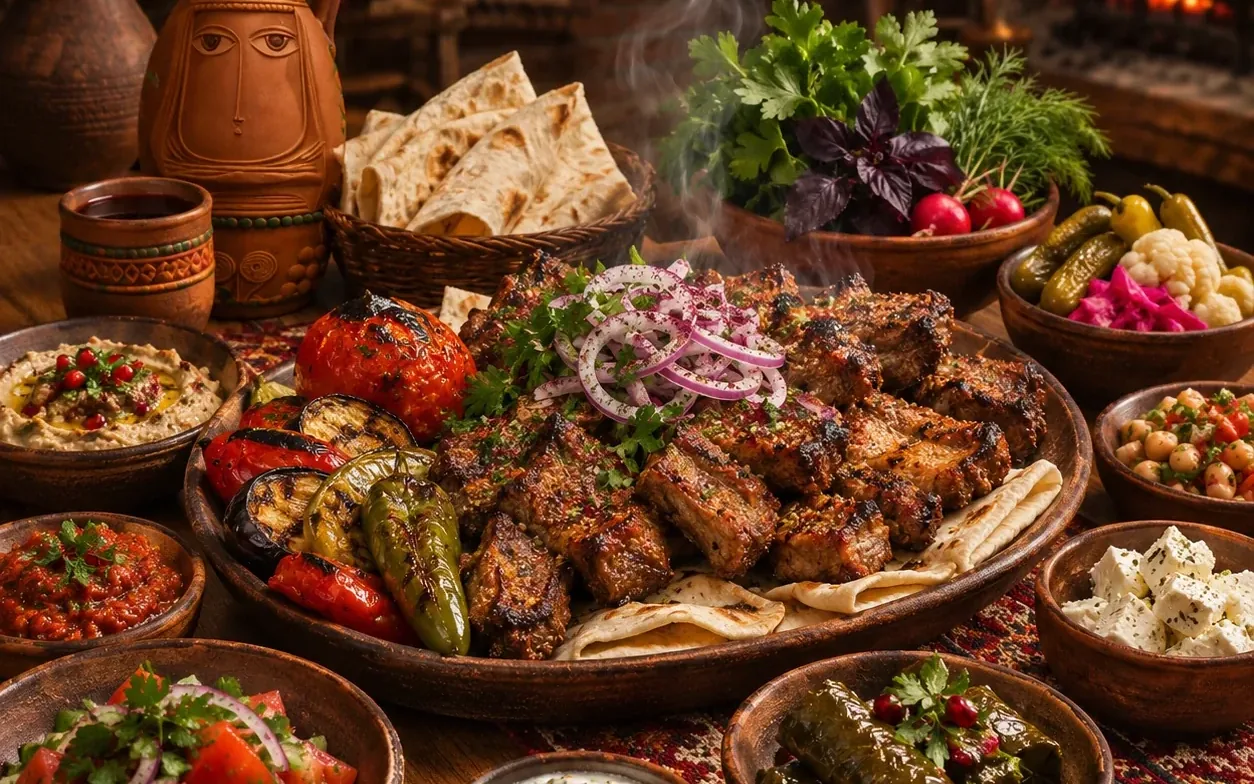
Much of the Armenian family table still follows the church calendar, and some of the customs that go with its feasts are thought to be older than Christianity. In the traditional way of life the fasts added up to some 160 days a year of beans, peas, onions, garlic and cucumbers, so a feast, when it came, was taken seriously. The year opens with the New Year week, ending with Christmas on 6 January; that table is a story of its own, so we start in midwinter.
One winter feast with food at its heart is St Sargis, the saint lovers turn to. It moves with Easter and falls in January or February. On the eve, after fasting, young people eat a very salty cake, aghablit, and go to bed without water: whoever brings them a drink in a dream will be their future spouse. A plate of pokhindz, flour made from roasted wheat, is also left outside overnight, and a hoofprint of the saint's horse in it is a sign of good fortune.
In mid-February comes Trndez. The church feast, Tyarnyndaraj, the Presentation of Christ in the Temple, falls on 14 February, forty days after 6 January, but the celebration belongs to the evening before. After the service, bonfires are lit in church courtyards with fire taken from the church, and couples, above all newlyweds, jump over the flames hand in hand for luck and children. In villages, pokhindz is handed round by the fire. The fire-jumping is generally seen as older than Christianity.
Then the table turns. Lent is preceded by Barekendan, a carnival that was once a fortnight of masks, games and generous food. Great Lent begins on the Monday after Bun Barekendan, the carnival's last day, and lasts forty days; the fast of Holy Week follows, so it runs right up to Easter. The strict fast excludes meat, dairy and eggs, and one of its Armenian names, aghuhatsk, means “salt and bread”, after the bread, salt and water that monks and many of the faithful once lived on. This is the season of pasuts, or Lenten, cooking: lentil and bean soups, chickpeas, pasuts tolma of pulses and grains, and wild and garden greens cooked in vegetable oil instead of butter.
Easter, Zatik, is the main feast of the Armenian Church. Eggs are hard-boiled and dyed red, traditionally in a brew of onion skins. In the 14th century the theologian Grigor Tatevatsi explained the custom: the egg is a model of the world, with the shell as the sky and the yolk as the earth, and the red colour means that the world was redeemed by the blood of Christ. Then comes the egg fight: two players tap their eggs together, and the one whose egg stays whole wins the broken one.
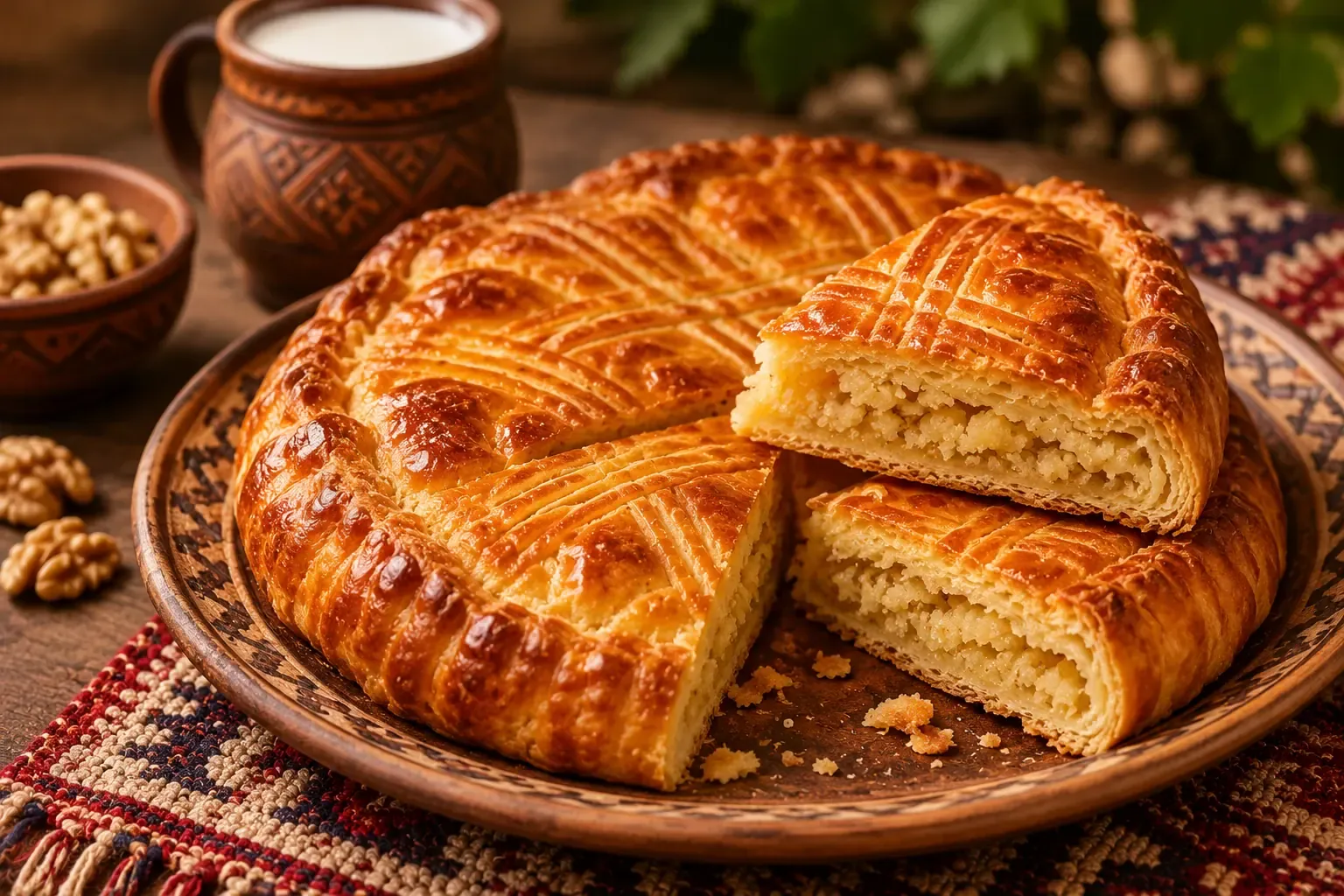
The Easter table has a settled shape: the red eggs, fish (often ishkhan, the Sevan trout), rice pilaf with raisins and dried fruit, fresh and fried greens, lavash and gata. People like to read meanings into its dishes, too: in one popular reading, the rice in the pilaf stands for humanity and the raisins for the faithful.
Summer brings the water festival of Vardavar, but the next feast with a table of its own falls in August. On the Sunday nearest 15 August the Armenian Church celebrates the Assumption of the Holy Mother of God, and after the liturgy the grapes are blessed. Traditionally no one ate the new grapes before this day, just as the year's first apple was kept for Vardavar. Vine growers brought their best bunches to church to be blessed, and many still call the feast simply Khaghoghorhnek, the blessing of the grapes.
Ararat Tavern, at 15 Sayat-Nova Avenue in central Yerevan, is open every day from 10:00 to midnight, and some of these flavours are on its menu: trout, sig and ishkhan dishes and Gata, as on the Easter table, and Pokhindz with ice-cream for a taste of February's roasted wheat. For a family gathering on a feast day, book a table in good time.